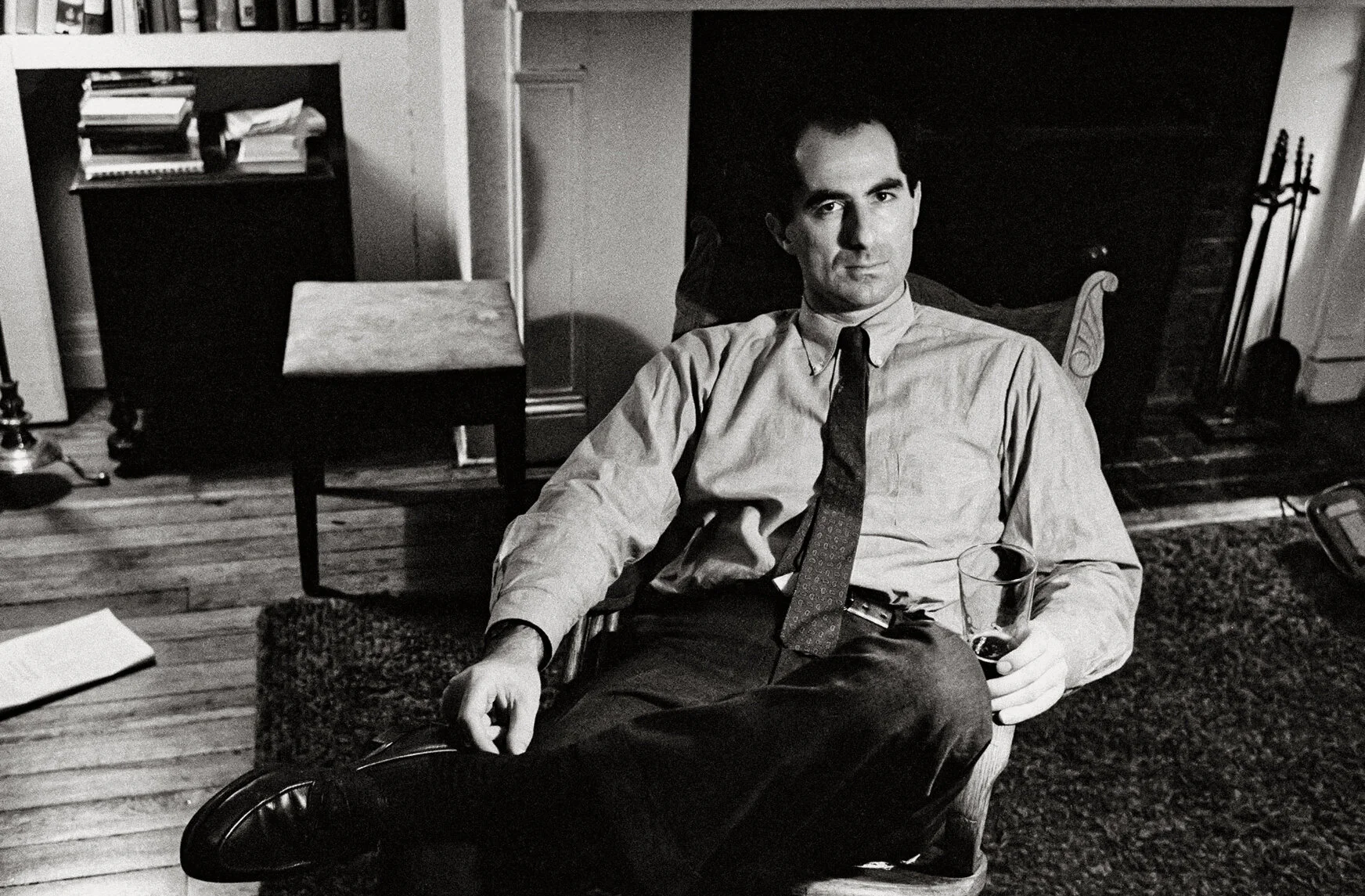
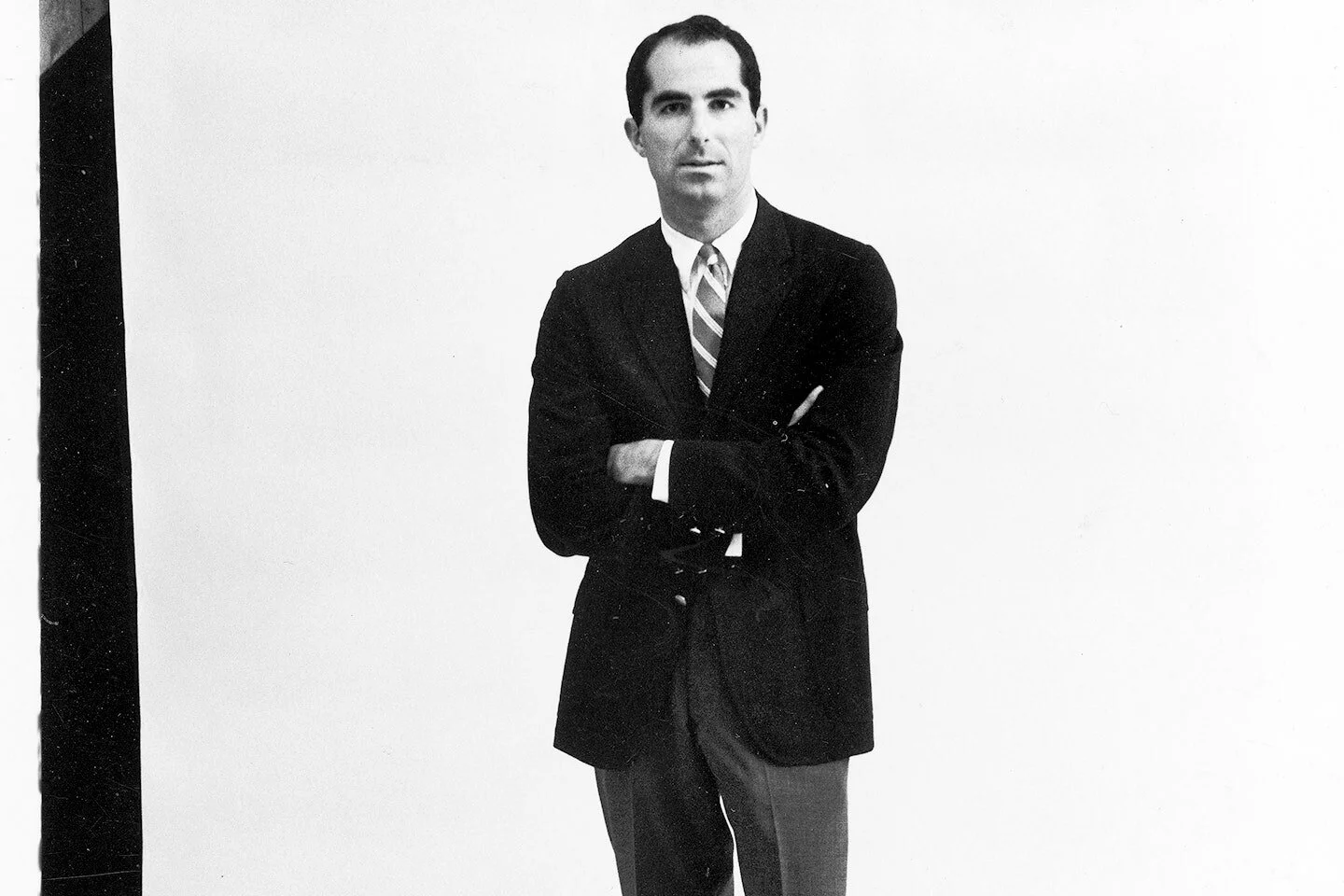
Philip Roth (1933–2018), one of the most celebrated American writers of the 20th century, was a son of Newark. As a student, he spent hours in this building, reading books that shaped his sense of literature and writing. Roth’s personal library of more than 7,000 volumes gathered over his lifetime and bequeathed to the Newark Public Library, reveals him not only as novelist, but as friend, teacher, and intellectual. This room creates a sense of how Roth chose to write and read. Books are shelved according to his own system with selected volumes displayed to show inscriptions, notes, and comments.
Enjoy your visit, whether as an introduction to Roth, or a chance to explore further his work and mind.
Why the Newark Public Library?
— Philip Roth
My decision to locate my personal library in Newark and, specifically, in the Newark Public Library was determined by a longstanding sense of gratitude to the city where I was born in 1933 and where I was raised in the Weequahic section during the middle of the last century. I had a happy childhood here. I lived throughout my school years in two-and-a-half family houses, first on Summit Avenue till I was nine and then on Leslie Street while I was finishing up at Chancellor Avenue Elementary School and after that attended Weequahic High, only a few blocks away from my house.
My library during those years was what was then called the Osborne Terrace Branch of the Newark Public Library. From about the 6th grade on I walked or bicycled to the branch library a couple of times a month to take out a bunch of books to read for pleasure. Mainly they were novels, in the beginning the great baseball books of John R. Tunis and the sea stories of Howard Pease, later the comic writing of Nathaniel Benchley and S.J. Perelman and the war reporting of Ernie Pyle and the battlefront cartoonist Bill Mauldin, later the excoriating satires of Philip Wylie and the left-leaning historical novels of Howard Fast, eventually at sixteen and seventeen, the hypnotically intense, rhapsodic extravaganzas of my first literary hero — in those years, everyone's first literary hero — Thomas Wolfe. All that treasure and more on little Osborne Terrace!
I spent my first year of college at what was then called Newark Rutgers — two small buildings, one on Rector St. and the other on Washington Pl., whose tiny campus, if you could call it that, shared by the students with every other Newarker passing by, was Washington Park. Facing the park on the northwest side was the grand facade of the main library, with its thousands and thousands of books and its gloriously inviting open stacks, where you could sit yourself down on the hard floor of a narrow aisle between the walls of shelves and find there, in front of you and behind you, above and below you, not only the book you were looking for but dozens more on the same subject that you had never heard of. You could sit there gorging on your subject until you couldn't bear any longer being cramped up on the floor and carried off as many books as you could manage to your seat at a table in the reading room.
During that first year at Newark Rutgers, during the many hours each day when I didn't have classes, the stacks and the reference room and the reading rooms of the main library were where I camped out when I wanted a quiet place to be alone to read or to study or to look something up. It was my other Newark home. My first other home.
I ask you, where else should my personal library be located?
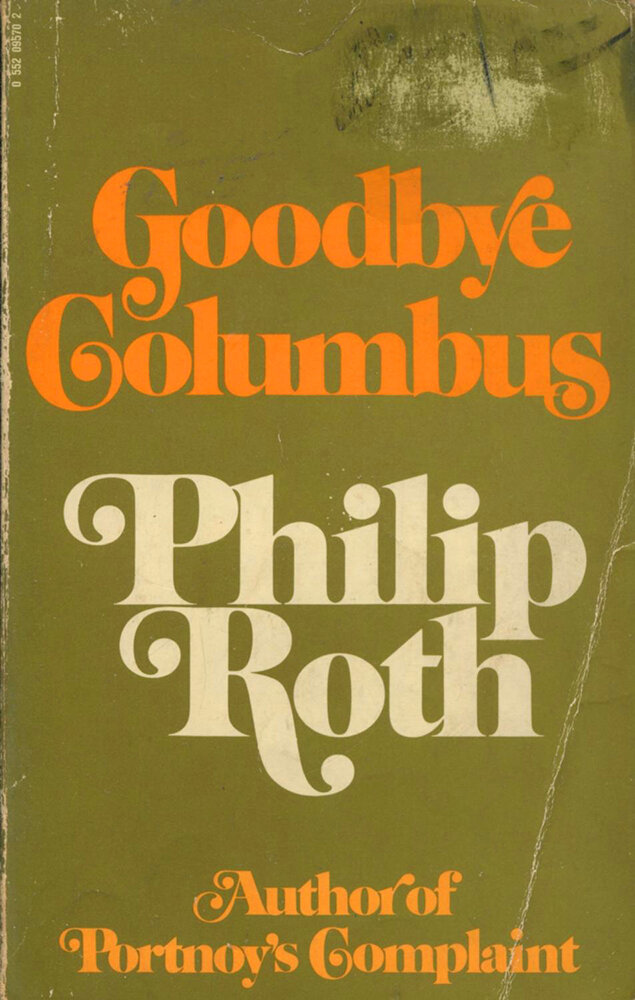
Philip Roth Identifies The Most Significant Works of Fiction He Read During the First Half of His Life


What is it:
Library & Exhibit
Lorem ipsum dolor sit amet, consectetur adipiscing elit. Ut imperdiet diam nisl, eu vehicula ipsum condimentum vel. Quisque eleifend facilisis mi eleifend malesuada. Ut turpis ipsum, condimentum sit amet interdum vitae, dictum ut magna. Sed vitae justo elit. Pellentesque habitant morbi tristique senectus et netus et malesuada fames ac turpis.